ADVENTURE 006
Where the Lines Lead
Alex Janvier
A story about art, memory, and what happens when a line carries more than colour.

Rob had followed roads, rivers, trails, and plenty of frisbees caught by the Wind. But he had never followed a painted line. When a red streak curled across the Alberta sky, Rob wondered where it was going. He didn’t yet know the better question was where it began.
Honouring National Day for Truth and Reconciliation
September 30 is the National Day for Truth and Reconciliation — a day to honour the children who never returned home, Survivors of residential schools, and the families and communities whose lives continue to be affected.
Alex Janvier was one of those children. He was taken from his family and sent to residential school, but his story did not end there. Through his art, Alex carried forward his identity, his memories, his connection to the land, and his voice.
This Adventure honours Alex’s remarkable life while also remembering the many Indigenous people whose stories include similar experiences of separation, loss, resilience, and strength.
May Alex’s story encourage us to listen, to learn, and to keep wondering about the stories that deserve to be remembered.
A Line in the Wind
Rob stood in an open field, tossing his frisbee into a steady Alberta breeze. One throw. Catch. Another throw. Catch. Then Rob let one fly a little higher.
The frisbee climbed, hovered… and stopped.
“Oh no,” Rob said. He knew that feeling. The Wind had found him again.
The frisbee tipped sideways and shot across the field. “HEY!” Rob ran after it, but this time the Wind didn’t carry his frisbee toward a falling apple, a bathtub, or a strange flying machine.
It carried it toward a line.
A bright red line stretched through the air ahead of him. It curved left, looped right, dipped toward the ground, then curled upward again.
Rob stopped running. “Okay,” he said. “That’s new.”
The red line wiggled, then continued across the field.
Rob followed.
A Line Going Somewhere
Soon another line appeared beside the first. Blue. Then yellow. Then white. They twisted around one another without ever becoming tangled.
Rob reached out to touch one. His finger passed straight through.
“Definitely new.”
The lines swept forward again, climbing over the top of a hill. Rob chased after them.
When he reached the top, he stopped.
Below him was a man painting. His brush moved slowly across the surface in front of him. Curve. Turn. Sweep. And every time the brush moved, the lines around Rob seemed to move too.

Rob looked at the lines, then at the painter, then back at the lines.
“Are you doing that?”
The man smiled. “I’m Alex.”
“Rob.”
Alex looked around. “Doing what?”
Rob pointed everywhere. “That.”
Alex dipped his brush into the paint again.
Rob watched another line curl through the air. “How do you know where it’s going?”
Alex kept painting. “Do you always need to know?”
Rob thought about that. “No. But I usually like to.”
Alex smiled.
That was not an answer.
Rob was getting used to those.
Following the Line
The red line began moving again, and Rob followed it past Alex’s paintings. Some were filled with bright colors and movement. Others made Rob slow down.
He wasn’t always sure what he was looking at.
A river? A road? The Wind?
Maybe none of them.
Maybe all of them.
Rob turned back toward Alex. “What is this one supposed to be?”
Alex looked at the painting, then at Rob.
“What do you see?”
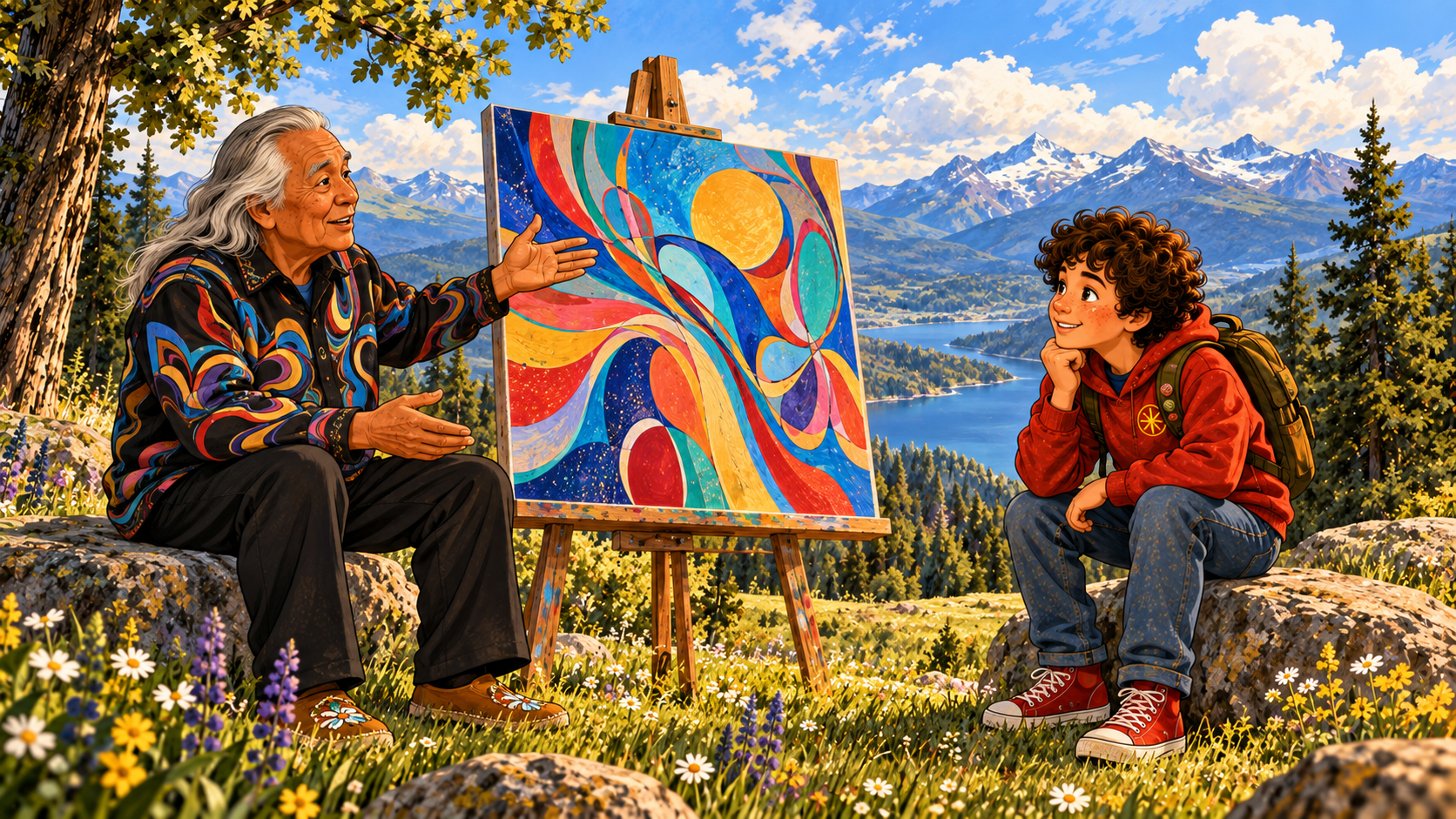
Rob stared at it again. He tilted his head one way, then the other.
“I see… something moving,” he said. “Maybe water. Or sky.”
He stepped closer.
“Actually, I’m not sure.”
Alex smiled.
Rob laughed. “You really like making me work for this, don’t you?”
The longer Rob looked, the more he noticed. Some lines seemed to race. Others wandered. Some moved together. Others pulled apart.
Maybe the paintings weren’t puzzles he was supposed to solve.
Maybe they were stories he was supposed to spend time with.
The Number
Rob moved closer to another painting.
Something near the bottom caught his eye.
Not a name.
A number.
287.
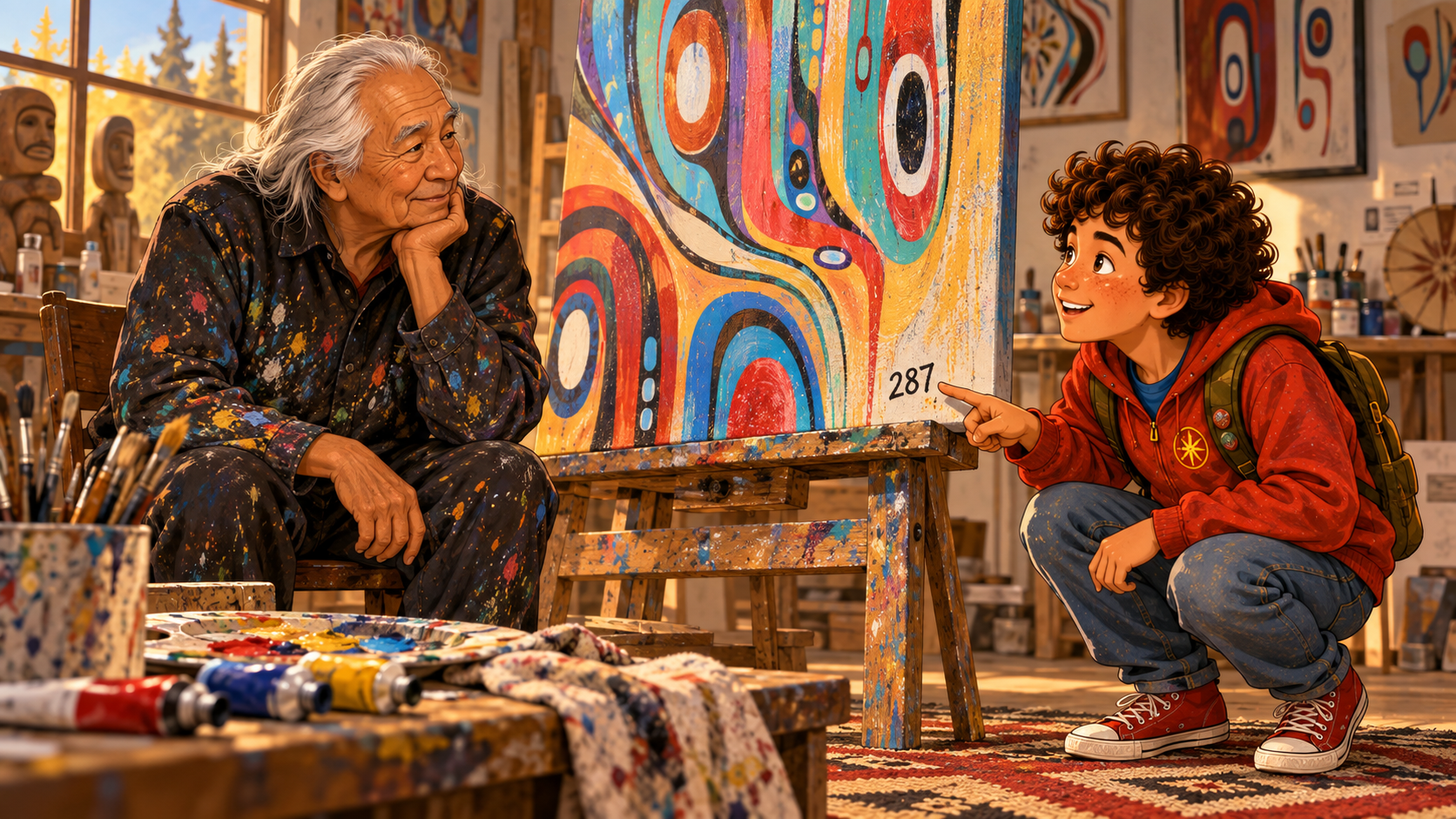
Rob pointed. “What’s that?”
Alex’s brush stopped.
For the first time since Rob had arrived, everything seemed a little quieter.
“Is that your signature?”
Alex looked toward the painting.
Rob knew Alex had a name. A family. A culture. A home. But 287 was a treaty number Alex had carried, and later he sometimes put it on his paintings.
Rob looked from the number to Alex.
“But that’s not your name.”
Alex shook his head.
Rob stared at the three digits again.
A number couldn’t tell him about the land Alex knew. It couldn’t tell him about his family, his memories, his language, or everything he had seen and experienced.
It couldn’t hold all the things that made Alex… Alex.
“So why put it there?” Rob asked.
Alex looked at the painting for a moment.
Then he picked up his brush again.
Rob didn’t press for an answer.
Maybe the number was there because some things shouldn’t disappear.
Maybe remembering could be part of the story too.
The Wind moved softly through the grass.
Then the red line began to move again.
More Than a Line
This time Rob didn’t chase it.
He walked.
The line carried him past paintings, colors, shapes, and stories. Rob began to understand that the line wasn’t only going somewhere.
It had come from somewhere.

From people.
From places.
From memories.
From things that brought joy.
And from things that hurt.
Rob watched Alex paint.
“Can a line tell a story?”
Alex raised his brush slightly. “What do you think?”
Rob sighed. “There it is again.”
Alex laughed.
The red line curled around another painting.
This time Rob didn’t ask what it meant.
He just looked.
He wondered where the line had been before it reached the canvas. What places it remembered. What people it carried. What stories lived inside it.
Then the red line suddenly rose into the air.
The blue followed.
Then yellow.
Then white.
They circled above Rob before stretching away together.
Rob looked at Alex.
“Are we following those?”
Alex smiled.
Rob grabbed his frisbee. “I knew you were going to say that.”
The Wind caught him.
WHOOSH.
Morning Star
Rob landed on his back.
Again.
“One of these days,” he muttered, “the Wind could just use a door.”
Then he looked up.
And forgot all about the landing.
Above him was a painting unlike anything he had ever seen. It stretched across an enormous dome, with colors and lines flowing outward in every direction.
Rob slowly stood.
“Whoa.”
He was beneath Alex Janvier’s Morning Star.
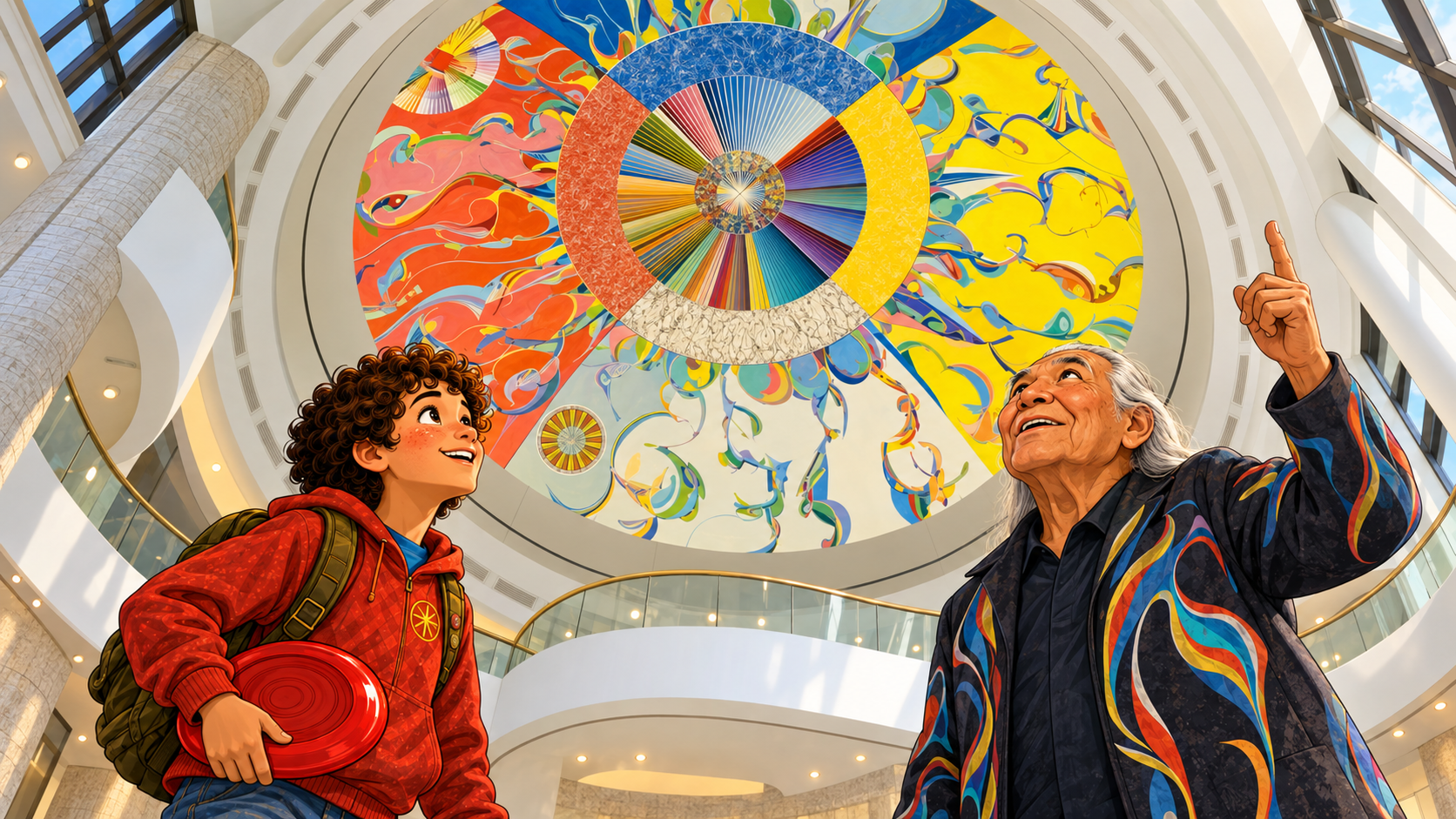
Rob turned in a slow circle. Everywhere he looked, there was something else to notice.
Red.
Yellow.
Blue.
White.
The same colors he had been following.
Except now there wasn’t one line.
There were thousands.
Alex stood nearby, looking upward.
Rob walked over to him.
“I think I figured something out.”
Alex waited.
“When I first saw the line, I wanted to know where it was going.”
Rob looked up again.
“But now I think I’m more curious about where it came from.”
Alex smiled.
Rob stared at the lines above them. They carried stories of the land, of change, of what had been lost, and of what could still continue.
“Because every line has to begin somewhere,” Rob said.
The Line Continues
The Wind began to stir.
Rob knew what that meant.
His time here was almost over.
He looked up once more at the lines stretching across Morning Star.
A line could begin with a brush.
Or a place.
Or a memory.
Or a person.
And maybe that was why two people could stand beneath the same painting and see something different. They brought their own stories with them too.
The Wind lifted Rob’s frisbee from his hand. It floated upward and curved through the air.
For just a moment, Rob imagined an invisible line following behind it.
He watched it bend.
Turn.
Keep going.
Rob reached up and caught the frisbee with his right hand.
Then he looked at Alex.
“Do you think a line ever really ends?”
Alex looked back toward the painting.
Rob waited.
Alex smiled.
Rob laughed. “Right. Another question.”
The Wind pulled at his jacket.
WHOOSH.

Rob landed back in the field where the adventure had begun.
The sky was quiet again. No red line. No blue. No yellow.
Just Rob, his frisbee, and the Wind.
He ran his finger around the edge of the disc.
A circle.
A line with no obvious beginning and no obvious end.
Rob looked across the field, then threw.
The frisbee climbed into the sky, following a path only the Wind could see.
Rob watched it go and wondered:
Where does a line begin?
Maybe with a brush.
Maybe with a memory.
Maybe with a story.
Or maybe…
with a question.
Keep wondering.
The Story Behind Alex Janvier
Alex Janvier was born in 1935 on Le Goff Reserve, part of Cold Lake First Nations in Treaty 6 Territory in Alberta. He was Denesuline and Saulteaux, grew up speaking Dene, and became one of Canada’s most influential Indigenous artists. His paintings became known for their flowing lines, bold colors, and shapes inspired by the land, sky, culture, memory, and his own life experiences.
When Alex was eight years old, he was sent away from his family to Blue Quills Indian Residential School. It was there that his artistic ability was recognized and encouraged, even as residential school separated him from important parts of his home, language, family, and culture. Experiences from this part of his life would later appear in his artwork. He eventually studied at the Alberta College of Art in Calgary, graduating with honors in Fine Arts in 1960.
Alex also helped change the way Indigenous art was viewed in Canada. In 1972, his work appeared alongside artists Jackson Beardy and Daphne Odjig in an important Winnipeg exhibition called Treaty Numbers 23, 287 and 1171. 287 was Alex Janvier’s treaty number. The following years brought together Janvier, Beardy, Odjig, Eddy Cobiness, Norval Morrisseau, Carl Ray, and Joseph Sanchez as the Professional Native Indian Artists Inc., sometimes called the “Indian Group of Seven.” Together, they challenged an art world that too often treated Indigenous artwork as craft or artifact rather than contemporary fine art. Their work helped open doors for generations of Indigenous artists who followed.
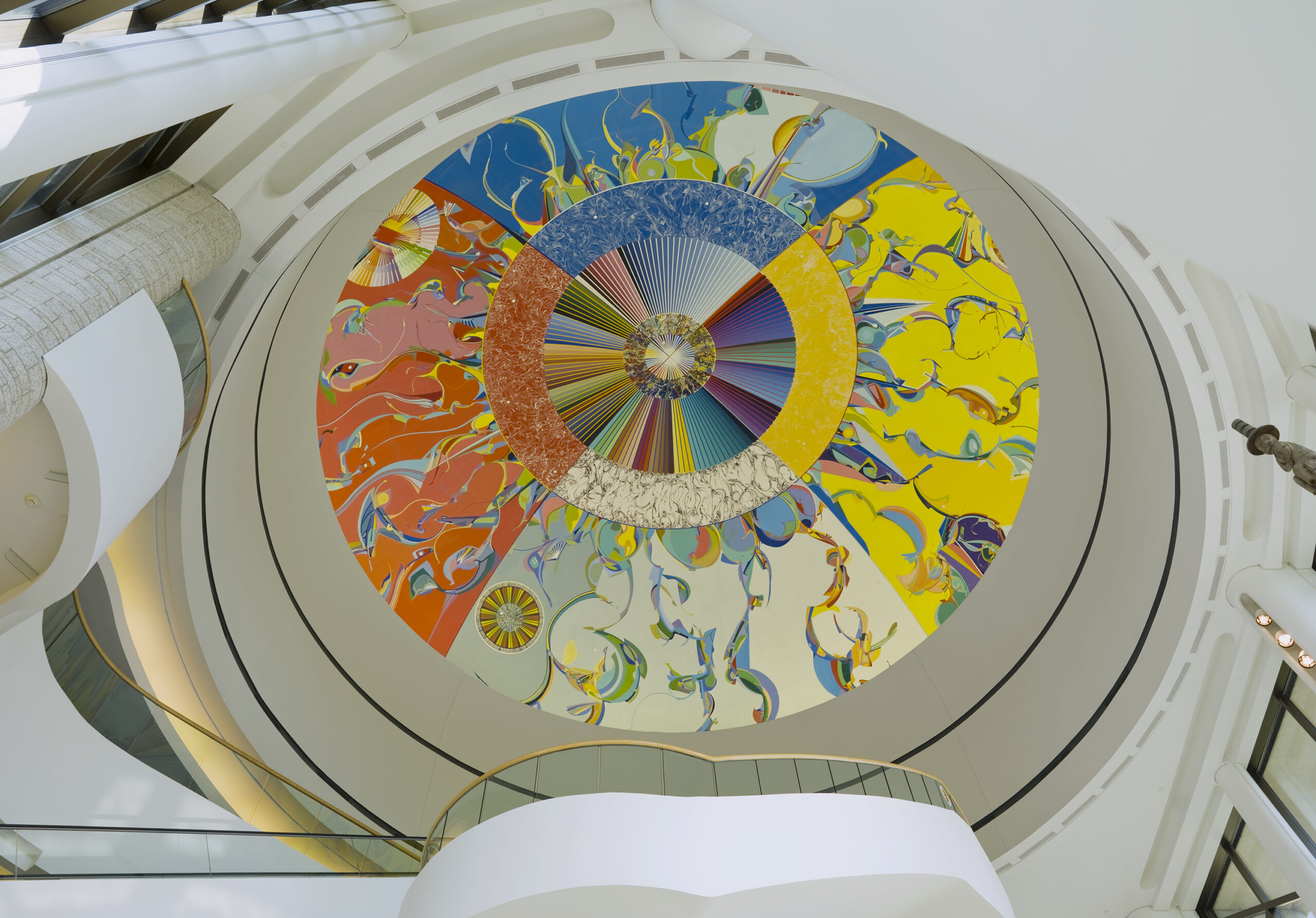
One of Alex’s most extraordinary works is Morning Star – Gambeh Then’, painted in 1993 with assistance from his son Dean. The enormous mural covers 4,500 square feet of the domed ceiling at the Canadian Museum of History. Its four sections tell a story of the land from an Indigenous perspective: life before European contact, the turbulence that followed contact, Indigenous revival, and hope for healing and reconciliation.
Over a career spanning more than six decades, Alex created thousands of paintings and major public artworks across Canada. His work was exhibited internationally, and his honors included the Order of Canada, the Governor General’s Award in Visual and Media Arts, and the Alberta Order of Excellence. He continued painting almost every day until near the end of his life. Alex Janvier died on July 10, 2024, at the age of 89.
What Alex left behind was more than paintings.
He helped make space for Indigenous artists to tell their own stories, in their own ways, and to be recognized as contemporary artists on their own terms.
And his lines are still telling those stories.